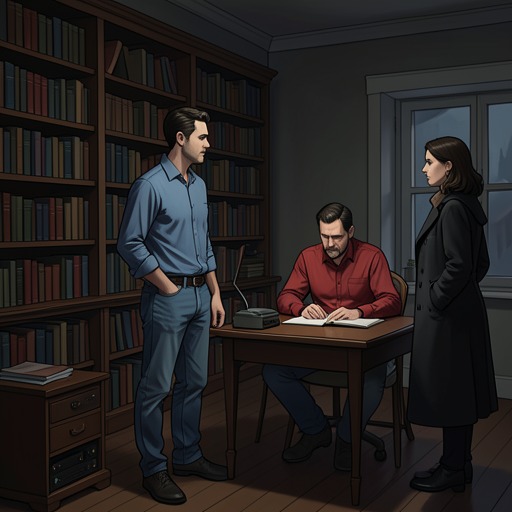
Harrison’s murder of Jake Scully
Crimson LakeHarrison’s murder of Jake Scully is revealed as both a calculated killing and the culmination of a widening plan: Harrison and Zoe Miller had begun by targeting Teresa, then imagined eliminating the adults who opposed them and taking over the lives those adults would leave behind. Jake was drawn to the pier by a deception that exploited his fear for his son. The trap Harrison had prepared turned a father’s attempt to protect his child into the means of his death.
Causes and Background
Harrison explained that the conflict began with Teresa, Zoe Miller’s mother. Teresa had opposed the young couple from the start, and Harrison described her hostility as frightening. Zoe wanted to run away, but Harrison believed that escape would not solve their problem; in his account, they needed to remain and change the situation. He said that, at first, Teresa was the only person they intended to remove. The eventual killing of Jake therefore followed an earlier decision to kill Teresa, rather than arising from a single sudden dispute at the pier.
Harrison framed his relationship with his father through the language of power and confinement. He imagined Jake as a godlike authority figure, yet also as someone unable to control his own household. After Teresa’s death, Harrison felt Jake had taken up the same opposition to the couple. The two of them, he believed, had already paid a terrible price for being together, and Jake’s effort to intervene seemed to him like another attempt to separate them. When Jake wrote to a rehabilitation ranch about sending Harrison away for six months, Harrison treated the plan as proof that his father intended to break up the relationship. That grievance made Jake, in Harrison’s eyes, another obstacle to be removed.
The Lure and the Trap
Harrison used the threat of an obsessive fan to bring Jake out at night. The letters had warned Jake that the supposed superfan would come for his son. Harrison then presented himself as having received a message from someone online who wanted to meet by the river and discuss Jake. The false message made the danger appear directed at Harrison, but Jake went in his place, believing he could confront the stranger and keep the threat away from his son. In reality, the stranger was a fiction and Harrison had arranged the meeting.
At the pier, Harrison led Jake into a concealed opening in the boards. The planks had been sawn through and fitted together over a sheer drop, forming a trap. The reconstruction of the killing comes when Ted recognizes that the same trap is beneath Amanda as she approaches Harrison on the pier. The present danger makes Jake’s earlier death briefly visible to Ted: Jake falling, reaching for the wood, and disappearing into the depths where a predator waited. The trap’s physical design links the two moments, while the deception behind it clarifies why Jake had come there at all.
From One Killing to a Plan
Harrison described Teresa’s death as changing the couple’s sense of what was possible. Afterward, he and Zoe wondered why they should not eliminate the others as well. They considered the idea of removing all the adults and holding a series of funerals and wakes; Harrison presented the discussion as initially casual, before Jake’s intervention gave it a new target. He also described Zoe’s father in hostile terms, and said that Jake’s opposition to the relationship brought back the conflict they had faced with Teresa.
The plan grew beyond a response to any one parent. Harrison imagined that, within two years, he and Zoe could take over the lives left behind by the adults. He pictured those adults as already living separately in an enormous house, avoiding one another on the stairs, and asked why they should be allowed to continue acting as authorities over the young couple. This imagined future does not lessen the deliberate nature of the murder: it shows how Harrison converted resentment and a desire for freedom into a rationale for killing. His false message and the prepared pier trap made that rationale operational.
Exposure and Significance
The murder’s truth emerges through evidence that contradicts the story Harrison had constructed around Ormund Smitt. Jake’s unfinished manuscript had been left untouched. Ted reasoned that a genuinely obsessive intruder who watched the household would have taken it, examined it, or referred to it in the letters. The untouched manuscript therefore undermined the idea that the supposed fan had been entering the house and threatening the family. Against that background, the letters’ warning about Harrison supplied the mechanism for the false meeting: Jake went out because he thought his son was in danger.
The revelation also reverses the meaning of Jake’s final action. He did not go to meet a stranger in pursuit of his own safety or curiosity; he went because he believed he could draw danger away from Harrison. Harrison exploited that parental instinct, then used the same pier trap that Ted recognizes during the later confrontation. The murder thus joins the larger plan against the adults to an intimate betrayal between father and son: Jake’s attempt to protect Harrison became the opening through which Harrison killed him.